Wi-Fi & 802.11
Wi-Fi 4 through Wi-Fi 7, the frame exchange hiding behind the word "connected," and how to read channels, bands and signal levels without kidding yourself.
Open track →From send() to the air. TCP/IP, Wi-Fi, RF, antennas and propagation, taken apart one layer at a time.
sock.sendall(b"GET / HTTP/1.1"):51514 → :80 [PSH, ACK] seq=1192.168.1.23 → 203.0.113.80QoS Data BSSID 02:4f:2a:9c:11:e0ch 36 · 5180 MHz · 80 MHz wideL0 · the air · λ ≈ 5.8 cm · FSPL ≈ 76 dB @ 30 m
Programming books stop at the socket. Radio books start at the feedpoint. Working with TCP Sockets lives in the gap between them: how your code opens a connection, how TCP/IP hauls the bytes around, how Wi-Fi squeezes them onto a channel, and what becomes of them between two antennas.
I built this website for the person who's used a socket a hundred times and never once asked what happens below it. I start with TCP/IP, the plumbing nobody sees, then climb outward through Wi-Fi, into RF, out to antennas and the stubborn physics of a signal crossing open air.
More about me →Each one picks up where socket code quits and runs until the signal is airborne.
Wi-Fi 4 through Wi-Fi 7, the frame exchange hiding behind the word "connected," and how to read channels, bands and signal levels without kidding yourself.
Open track →Frequency, wavelength, decibels, gain. Antenna types, radiation patterns, and a calculator for cutting your own.
Open track →Path loss, multipath, Fresnel zones, walls. Build a link budget and know if the link holds before you climb the mast.
Open track →SYN, SYN-ACK, ACK. The TCP handshake costs one full round trip before your first byte of data.
The standard Ethernet MTU. Take off 40 bytes of IPv4 and TCP headers and you get a 1460-byte MSS.
A common minimum signal target when designing Wi-Fi for voice and video calls.
The wavelength at 2.4 GHz. Half of it is a dipole antenna you can cut by hand.
Twice the power. +10 dB is ten times, and every 6 dB of extra budget doubles free-space range.
The three non-overlapping 20 MHz channels in the 2.4 GHz band in North America.
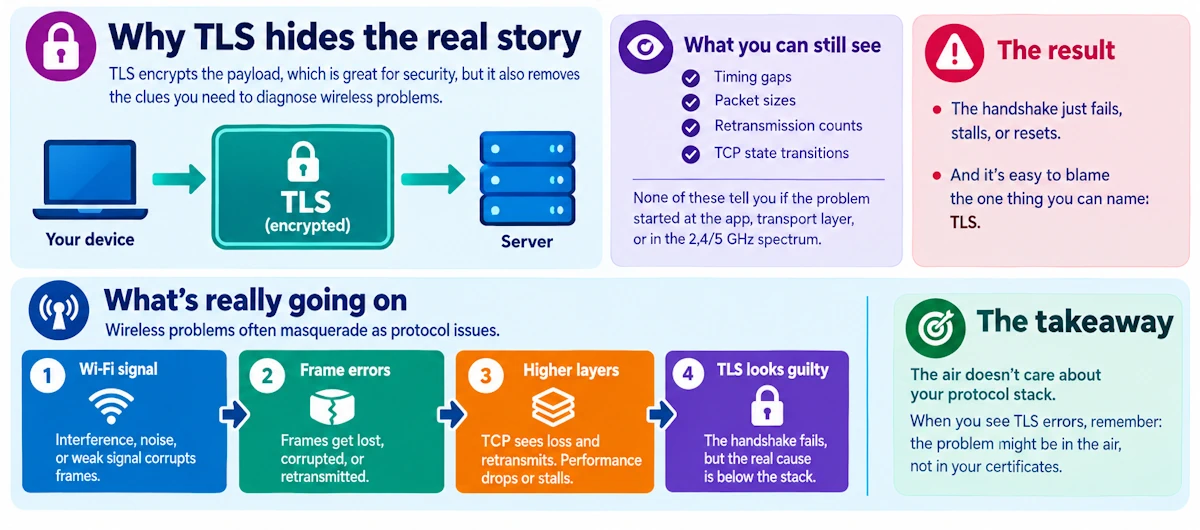
Here's a scenario I've seen happen more times than I can count. A handshake fails. Somebody glances at the logs, sees "TLS" in the error, and spends the next three hours fiddling with cipher suites and certificate chains. Meanwhile the actual culprit is sitting eighteen inches away, radiating on channel 6, fighting for airtime with a neighbor's baby monitor.
Read More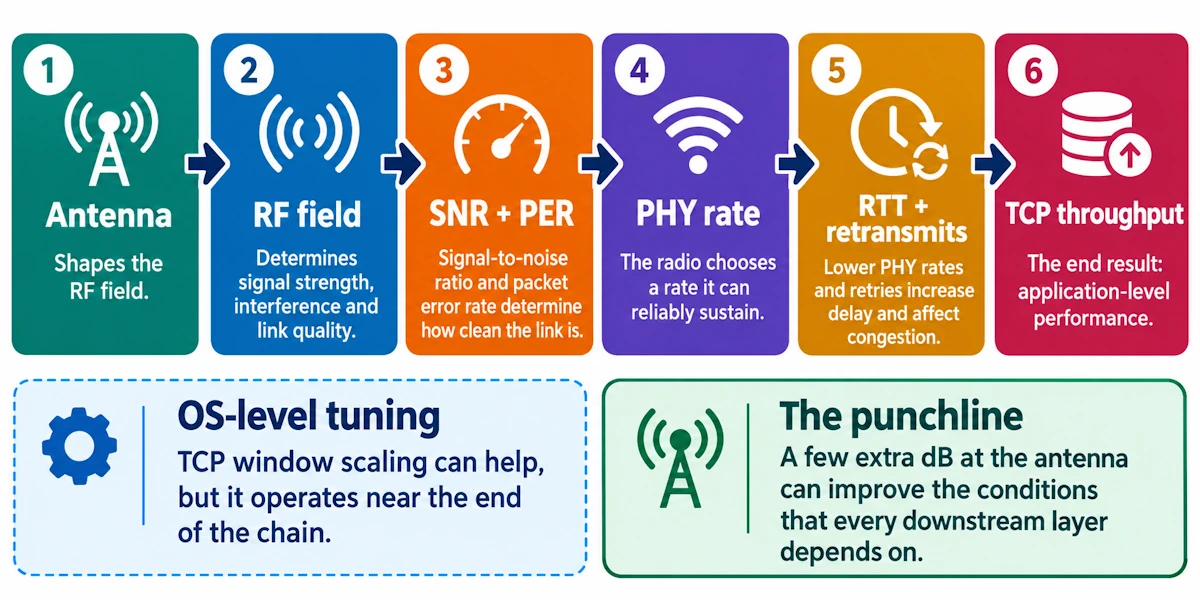
Your download crawls. You stare at the progress bar, blame your ISP, restart the router, then blame the cloud. Here's the thing nobody tells you in the beginner forums: that stutter might have nothing to do with your provider and everything to do with a two-inch piece of metal sticking out of your access point - the directional WiFi antenna. Antennas shape the invisible field that every packet has to swim through before it ever touches a socket.
Read More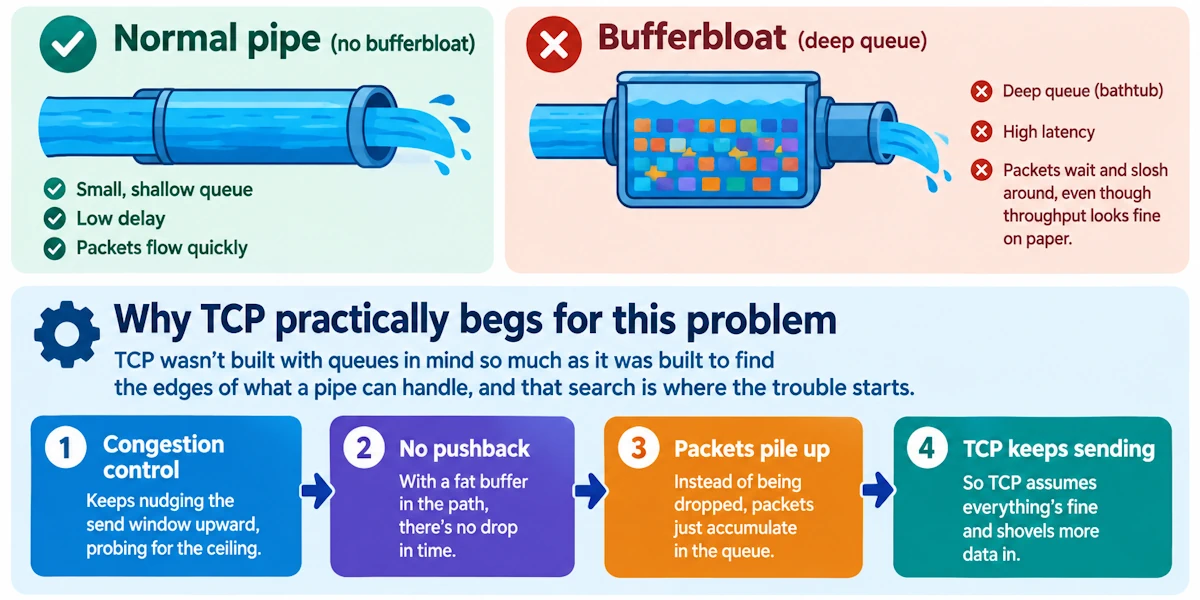
Your bandwidth test says 400 Mbps. Your video call freezes like a deer in headlights anyway. Something's lying to you, and it's not your ISP - it's the queue sitting quietly between your laptop and the rest of the internet. Bufferbloat is a plain enough idea once you see it: too much queuing stacked inside routers, drivers, and chipsets, turning what should be fast delivery into a waiting game.
Read MoreEvery term on the site is defined in plain language, with a tag showing which layer it belongs to.
Open the glossary →The operating system's handle for one end of a network conversation. For TCP, a connection is identified by protocol, source IP and port, and destination IP and port.
How much unacknowledged data the sender lets itself have in flight. It grows while ACKs arrive smoothly and shrinks when packets are lost.
Received Signal Strength Indicator, usually reported in dBm. A larger (less negative) number means a stronger signal, so −55 beats −75.
The football-shaped region around the direct path between two antennas. Keep about 60% of the first zone clear or the link loses signal even with line of sight.
One email every other week: one networking concept, one packet capture, one fix. No tracking pixels, and you can unsubscribe with one click.
// sent every other Friday