Teaching an Old Socket New Tricks: Modern TCP Stack Features That Improve Wireless UX
Blame the right culprit for once. That 300 millisecond stall before your video call recovers, that maddening pause before a page finally loads on hotel Wi-Fi, these aren't always signal problems. Half the time they're software problems wearing a signal problem's coat. I've watched the same radio link produce a sluggish mess on one laptop and a snappy sub-100ms response on another - same antenna, same access point, same spot on the sofa. The difference lived entirely in the stack. This piece is about what changed, and what you can change too.
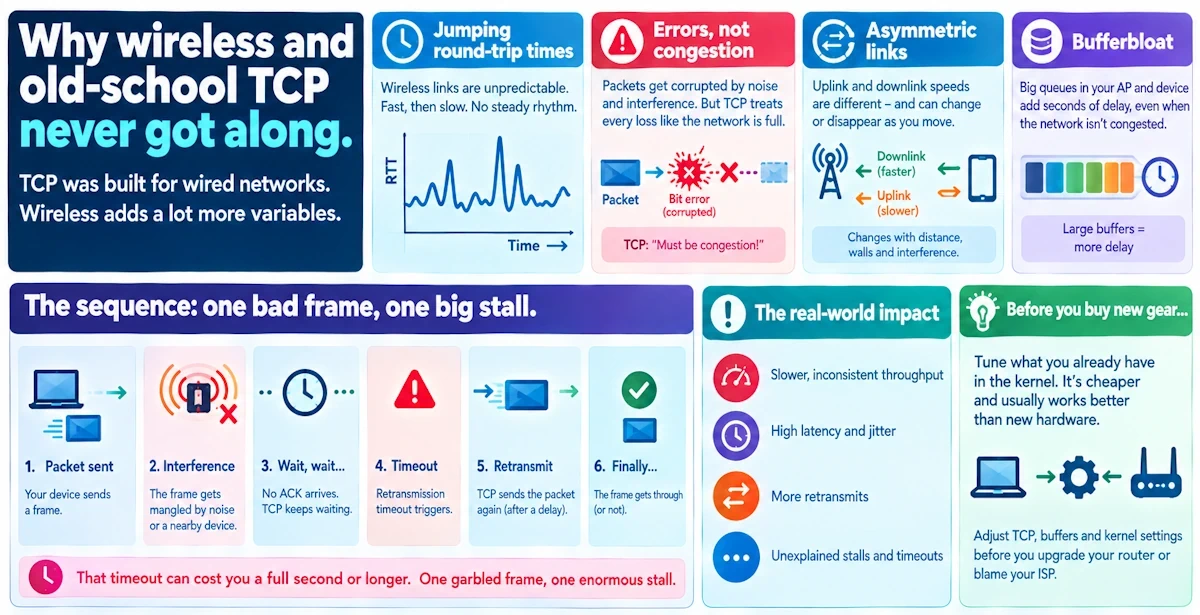
Why wireless and old-school TCP never got along
TCP was built on assumptions that make sense for wired Ethernet and fall apart the moment radio gets involved. Round-trip times on wireless links jump around constantly, short bursts of speed followed by dead air. Packets get mangled by bit errors rather than genuine congestion, yet classic TCP treats every lost packet as proof the network is overwhelmed. Uplink and downlink capacity rarely match on cellular or Wi-Fi, and that capacity itself can vanish and reappear as you walk past a wall. Then there's bufferbloat, those generous queues sitting inside your access point and handset, quietly adding seconds of delay nobody asked for.
Picture the sequence: a packet goes out, gets clobbered by interference, the sender waits, waits some more, finally gives up and triggers a retransmission timeout. That timeout can cost you a full second or longer. One garbled frame, one enormous stall. Before you go buy a better router or shout at your ISP, tune what you've already got sitting in the kernel. That's the cheaper fix and usually the more effective one.
The modern arsenal worth knowing
A handful of features matter here, and they don't deserve equal airtime. Some are the whole ballgame.
Congestion control modernizers, BBR and its kin, change the entire philosophy. Classic algorithms like Cubic treat packet loss as a congestion signal and back off hard. BBR instead builds a running model of bottleneck bandwidth and round-trip time, probing gently rather than panicking. On a flaky wireless hop, that's enormously valuable, because a dropped packet from a burst of interference doesn't mean the network is drowning, it means a leaf rustled near the antenna. BBR shrugs that off and keeps moving, finding available capacity again faster once conditions improve. There are tradeoffs worth knowing: BBR can behave unfairly when sharing a bottleneck with loss-based flows, and older middleboxes sometimes choke on its pacing patterns. On Linux you switch it with a line like “sysctl net.ipv4.tcp_congestion_control=bbr”, assuming your kernel compiled the module. Avoid it on paths with heavily congested downstream hops where loss genuinely does mean congestion.
Loss recovery got smarter too. SACK and FACK let a receiver tell the sender exactly which segments arrived, so retransmission becomes surgical rather than wholesale. Tail Loss Probe and RACK go further, probing aggressively when the last packets in a burst go missing, recovering without waiting through a punishing retransmission timeout. For anything interactive (a game, a voice call, a chat app, etc) this is the difference between a hiccup and a conversation-killing freeze. F-RTO helps stacks avoid declaring a timeout spuriously after the link layer already quietly fixed things on its own. Most of this ships enabled by default in contemporary kernels, but it's worth checking rather than assuming.
Packet pacing smooths out the bursts that would otherwise slam into an access point's queue all at once, cutting down on both bufferbloat and the airtime collisions that plague crowded Wi-Fi channels. ACK behavior matters too: delayed ACKs save bandwidth on bulk transfers but can hurt latency-sensitive traffic, and on asymmetric links watch for ACK decimation, where the return path simply can't keep up with acknowledging every packet.
ECN lets routers mark packets instead of dropping them, a quieter signal that avoids the whole retransmission dance. It needs cooperation end to end, client, server, and every hop in between, and pairs beautifully with queue management schemes like CoDel or PIE that actively fight bufferbloat rather than letting queues grow unchecked. Middlebox compatibility remains the sticking point.
Multipath TCP deserves a mention as the ambitious option: it lets a single connection use Wi-Fi and cellular simultaneously, failing over without the user noticing a thing. Apple uses it in production for Siri. The complexity of middlebox cooperation keeps it from being universal, but where it works, it's genuinely remarkable.
Socket-level knobs you can actually touch
Here's where theory becomes a terminal window. “TCP_CONGESTION” via setsockopt picks your algorithm per socket. “TCP_NODELAY” disables Nagle's algorithm, worth flipping on for anything interactive where small packets need to leave immediately rather than waiting to batch up. “TCP_USER_TIMEOUT” lets you shorten how long the stack tolerates silence before declaring a connection dead, which matters enormously for perceived responsiveness on a wobbly radio link. Watch your “SO_SNDBUF” and “SO_RCVBUF” sizes too; oversized buffers are a classic bufferbloat trap, autotuning usually does better than a hardcoded guess. For debugging, “TCP_INFO” and the command “ss -ti” will show you retransmit counts and RTT estimates without any guesswork.
The bigger picture beyond your socket
None of this works in isolation. Your access point needs AQM running, CoDel or PIE, or the queue sitting there will undo everything you just configured. Driver and firmware updates matter more than people assume, because aggregation and rate selection behavior lives there. When troubleshooting, pull in signal strength and airtime utilization alongside your TCP stats, because a clean-looking stack can still suffer from a congested channel nobody's measuring.
A quick recipe for a sluggish app on flaky Wi-Fi
Confirm SACK and TLP are active. Switch the server to BBR if it supports it. Trim your send buffer and set a sane “TCP_USER_TIMEOUT” instead of letting the app hang indefinitely. Check your access point for bufferbloat and turn on CoDel if it's available. Expect fewer multi-second stalls and a noticeably snappier click-to-response feel within minutes of testing.
Modernize the stack before you blame the spectrum. Audit what your kernel is actually running, experiment on a spare device, and email me your findings, I want to see what you find.